
The Happy Prince: A Timeless Tale Of Sacrifice And Selfless Love
The Happy Prince is a deeply moving short story about a golden statue and a tiny swallow who discover the true meaning of happiness through sacrifice. This emotional narrative explores how selfless love can transform a city, offering a profound moral lesson for readers of all ages.
| Feature | Details |
| Genre | Moral Fiction / Fairy Tale |
| Reading Time | 6–8 minutes |
| Suitable For | Adults and Children (Bedtime Story) |
The Story
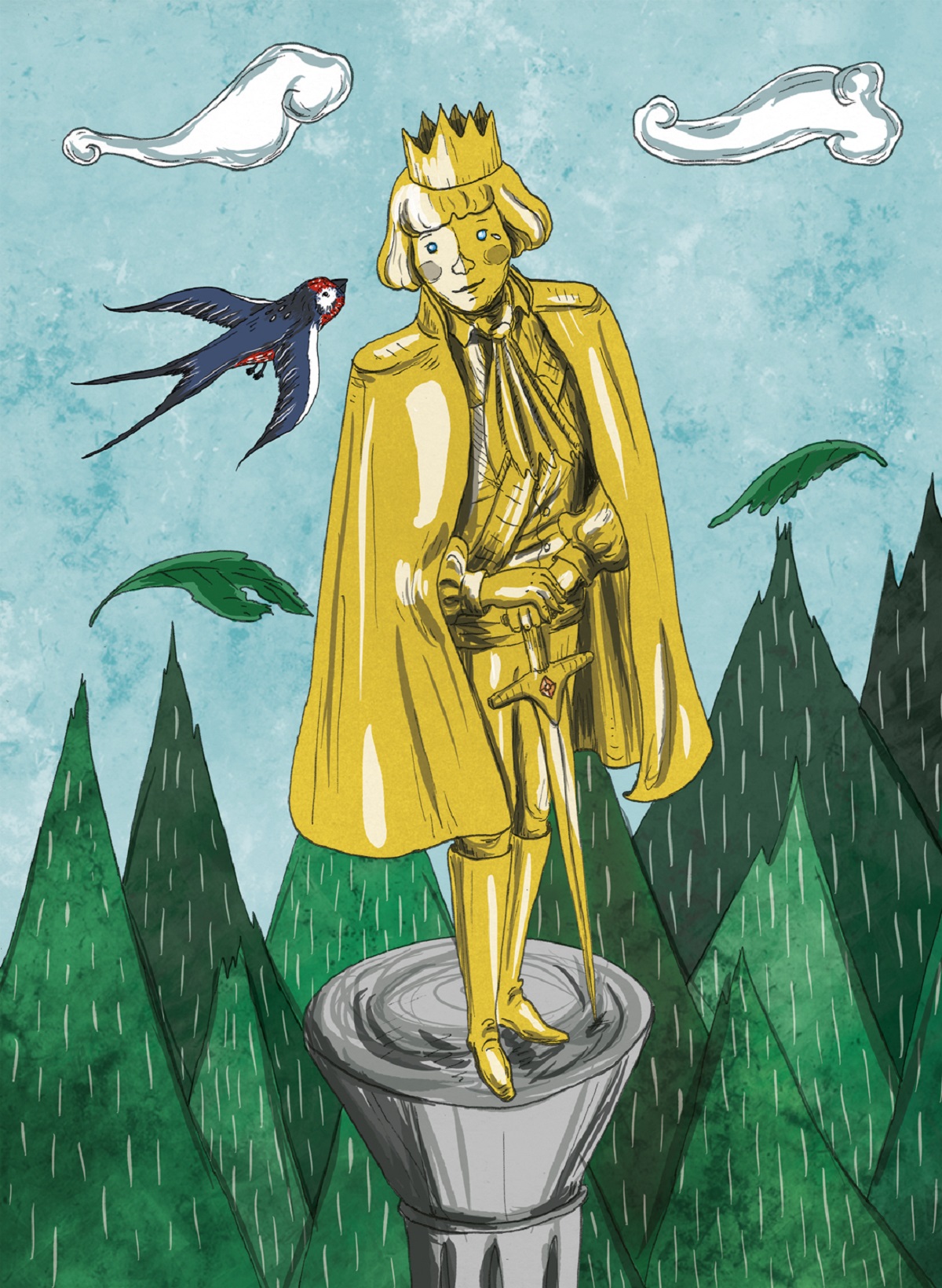
The winter winds were beginning to bite, whispering of the coming frost. High above the town, perched on a pedestal of cold stone, stood the statue of the Happy Prince. He was a marvel of the world—gilded with thin leaves of fine gold, his eyes two shimmering sapphires, and a large red ruby glowing on his sword hilt.
Below him, a tiny swallow flitted through the twilight. His friends had already flown to the warm reeds of Egypt, but he had lingered for love of a reed. Now, shivering and alone, he sought shelter.
“I will put up there,” the swallow chirped, landing between the golden feet of the Prince. “It is a fine position with plenty of fresh air.”
But as he tucked his head under his wing, a large drop of water fell upon him. Then another. He looked up, his tiny heart fluttering in surprise. The sky was clear and the stars were bright, yet the Happy Prince was weeping.
“Who are you?” asked the swallow, wiping his damp feathers.
“I am the Happy Prince,” the statue replied, his voice like the low chime of a distant bell.
“Why do you weep then?” the swallow asked. “You have quite drenched me.”
“When I was alive and had a human heart,” the Prince began, “I did not know what tears were. I lived in the Palace of Sans-Souci, where sorrow was not allowed to enter. My courtiers called me the Happy Prince, and happy indeed I was, if pleasure be happiness. But now that I am dead, they have set me up here so high that I can see all the ugliness and all the misery of my city.”
The swallow shifted, feeling a prick of empathy he hadn’t expected from a bird of passage.
“Far away,” the Prince continued, “in a little street, there is a poor house. Through the window, I can see a woman. Her face is thin and worn, and she has coarse, red hands, all pricked by the needle, for she is a seamstress. In a corner, her little boy is lying ill. He has a fever and is asking for oranges. His mother has nothing to give him but river water, so he is crying. Swallow, swallow, little swallow, will you not bring her the ruby out of my sword hilt?”
“I am waited for in Egypt,” the swallow sighed. “My friends are flying up and down the Nile.”
“Swallow, swallow, little swallow,” the Prince pleaded, “will you not stay with me for one night and be my messenger? The boy is so thirsty, and the mother is so sad.”
The swallow looked at the Prince’s sorrowful face and felt a wave of compassion. “It is very cold here,” he said, “but I will stay with you for one night.”
The next morning, after delivering the ruby, the swallow prepared to leave. But the Prince had seen a young playwright freezing in a garret, his ink frozen, his stomach empty.
“Little swallow,” said the Prince, “take out one of my sapphire eyes and give it to him.”
“Dear Prince,” the swallow cried, “I cannot do that!”
“Swallow, swallow, little swallow,” the Prince commanded gently, “do as I ask you.”
And so, the swallow plucked out the eye and flew to the student. Day after day, the pattern continued. The second sapphire went to a match-girl whose matches had fallen in the gutter. As the Prince gave away his eyes, he became blind.
“I cannot leave you now,” the swallow whispered, settled permanently at the Prince’s feet. “I will stay with you always.”
The swallow became the Prince’s eyes, flying over the city and reporting the suffering of the poor. To feed them, the swallow picked off the leaves of fine gold, layer by layer, until the Prince looked dull and grey. But the faces of the hungry children grew rosy, and they laughed in the streets.
Then the snow came. The poor little swallow grew colder and colder, but he would not leave the Prince; he loved him too much. He picked up crumbs outside the baker’s door and tried to keep himself warm by flapping his wings.
“Goodbye, dear Prince,” he murmured at last, his strength failing.
“I am glad you are going to Egypt at last,” said the Prince, not knowing the end was near.
“I am not going to Egypt,” said the swallow. “I am going to the House of Death.”
He kissed the Happy Prince on the lips and fell down dead at his feet. At that moment, a curious cracking sound rang inside the statue, as if something had broken. It was the Prince’s leaden heart, snapping in two under the weight of a devastating loss.
The next morning, the Mayor walked by. “Dear me! How shabby the Happy Prince looks!” he exclaimed. “He is no longer beautiful, so he is no longer useful.”
They pulled down the statue and melted it in a furnace, but the broken leaden heart would not melt. They threw it on a dust heap where the dead swallow was also lying.
And God said to one of His Angels, “Bring me the two most precious things in the city.”
The Angel brought Him the leaden heart and the dead bird.
“You have rightly chosen,” said God, “for in my garden of Paradise, this little bird shall sing for evermore, and in my city of gold, the Happy Prince shall praise me.”
Moral / Message
The moral of the story is that true beauty is not found in outward gold or jewels, but in charity, sacrifice, and selfless love. It teaches us that the greatest riches are those we give away to help others.
“He is no longer beautiful, so he is no longer useful,” said the Art Professor. But the heavens knew that beauty is measured by the soul’s capacity to love.
Author:
— M Muzamil Shami
FAQs
What is the main theme of The Happy Prince?
The story focuses on the contrast between outward appearance and inner worth, emphasizing that compassion and sacrifice are the only paths to true happiness.
Why does the Happy Prince cry?
Despite being a “Happy Prince” in life, his statue is placed so high that he can finally see the systemic poverty and suffering of his people, which breaks his heart.
Is The Happy Prince a tragic story?
While the ending is physically tragic as both characters die, it is spiritually triumphant. Their souls find eternal peace because of their selfless love.
What does the swallow symbolize in the story?
The swallow represents the transformative power of devotion. He begins as a self-centered bird but ends as a martyr for the sake of friendship and kindness.
Read more short stories on StoryNest
Explore bedtime stories for kids
Discover fairy tales with moral lessons