
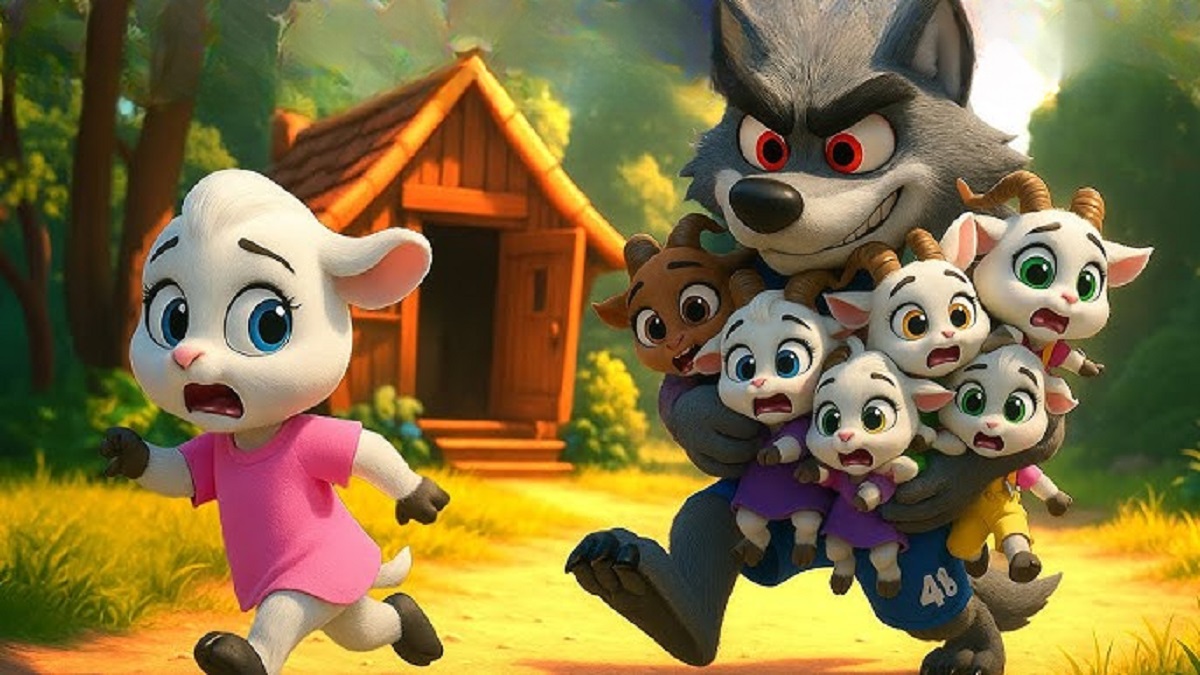
The Wolf and the Seven Little Kids: A Tale of Love, Bravery, and Deception
The Wolf and the Seven Little Kids – A Timeless Journey of Maternal Love and Clever Survival
In this deeply moving retelling of The Wolf and the Seven Little Kids, we explore the harrowing moment a mother’s intuition meets a predator’s greed. It is a story of hope, betrayal, and the unbreakable bond of family, proving that even the smallest heart can hold the greatest courage.
| Detail | Information |
| Genre | Fairy Tale / Moral Fiction / Romanticism |
| Reading Time | 8–10 Minutes |
| Suitable For | All ages (Bedtime, Classroom, or Solo Reading) |
The Wolf and the Seven Little Kids
The golden sun dipped behind the jagged peaks of the Elder Woods, casting long, dancing shadows over a small stone cottage. Inside, the air smelled of dried lavender and fresh hay. An old mother goat, her coat silvered by time, stood by the hearth, her heart heavy with the necessity of the coming journey.
“Dear children, the cupboards are bare,” she said, her voice a soft melody against the crackle of the fire. “I must go out immediately to run some errands in the village. The winter stores are low, and my precious little ones must not go hungry.”
“OK, Mummy,” chanted the seven little kids in a chorus of high-pitched bleats. They were a tumbling heap of soft fur and innocent eyes, the youngest barely tall enough to reach the latch of the heavy oak door.
The mother goat knelt, looking into each of their faces. “While I am gone, you must be on your guard at all times. I have seen a beastly wolf lurking near the stream. He is a master of shadows and lies. If you let him in, he is sure to gobble up the lot of you.”
The smallest kid shivered, pressing against his mother’s flank. “But how will we know it is him, Mummy?”
“You will know it is him straight away by his deep gruff voice and his big hairy feet,” she promised, licking the top of his head. “Trust your ears and your eyes, but most of all, trust your heart.” With a final, lingering look of maternal longing, she stepped out into the mist, her hooves clicking rhythmically against the stone path until silence reclaimed the clearing.
Thirty minutes passed—long enough for the kids to start a game of hide-and-seek—when a heavy thud echoed against the door. Knock. Knock. Knock.
“Dear children, I’m home,” a voice rumbled, sounding like gravel shifting in a stream. “I’ve returned with a special treat for each of you to enjoy. Open the door for your mother.”
The smallest kid froze, his ears twitching. He turned to the others and whispered, “That isn’t Mummy’s voice. It’s much too deep. This must be the wolf.”
Gathering their courage, the siblings shouted in unison, “We will NOT open the door! You have a deep gruff voice, and our Mummy has a soft, tender voice. You are the beastly wolf! Be gone! Be gone!”
A low growl vibrated through the wood of the door, followed by the sound of retreating footsteps. The wolf was gone, but his hunger was a fire that would not be extinguished. He sprinted to the local shop, his eyes gleaming with a wicked intelligence. There, he bought a large lump of chalk and swallowed it whole. The dry powder coated his throat, smoothing the rough edges of his snarl into a silky, deceptive hum.
He returned to the cottage, his heart thumping with anticipation. “Dear children, I’m home,” he called out. This time, his voice was a near-perfect mimic of the mother goat’s gentle tone.
“Mummy’s back!” shouted the youngest, racing toward the latch.
“Wait!” cried the eldest sister, catching him by the scruff. “Look under the door!” In the sliver of light beneath the oak frame, they saw two massive, dark, and hairy wolf’s feet.
“We will NOT open the door!” they bleated defiantly. “You have horrible, hairy feet, and our Mummy has lovely, dainty goat’s feet. You are the beastly wolf! Be gone!”
Frustrated, the wolf roared in silence. He was a creature of the hunt, and he would not be outsmarted by children. He fled to the village baker, demanding his paws be wrapped in dough under the guise of an injury. The baker, trembling, complied. Next, the wolf found a miller and thrust his dough-covered paws into a bag of white wood shavings and flour. When he pulled them out, they were as white as the driven snow.
For the third time, the wolf stood before the cottage. Knock. Knock. Knock.
“Dear children, I’m home. I’ve returned with a special treat.”
The kids crowded the door. “Show us your feet!” they cried. The wolf slid his white, floury paws under the crack.
“It sounds like Mummy. And the feet are white like Mummy’s too!” Relieved and hungry for affection, they threw open the door.
The air in the room turned cold as the beastly wolf pounced. Chaos ensued. The children scattered like autumn leaves in a gale. One dove under a chair; a second vanished into the bedclothes; the third jumped into the cold oven. Four, five, and six squeezed into the pantry, while the seventh—the smallest—scrambled into the belly of the great grandfather clock.
One by one, the wolf sniffed them out. His jaws snapped, and he swallowed them whole in his greed, not even pausing to chew. Only the smallest, hidden behind the rhythmic tick-tock of the clock, remained undiscovered. Sated and heavy, the wolf waddled into the meadow and fell into a deep, snoring sleep under an old oak tree.
When the mother goat returned, her world shattered. The door stood ajar; the cottage was a ruin of broken chairs and torn pillows. “My children!” she wailed, her voice breaking the stillness.
“Mummy? Mummy, I’m here!” A tiny voice emerged from the grandfather clock. The mother goat pulled her youngest out, and through his sobs, the story of the betrayal spilled out.
But mother goats are made of sterner stuff than grief. Armed with a pair of scissors and a sewing kit, she led her youngest to the sleeping beast. She saw his belly twitching—the children were alive! With the precision of a surgeon and the fury of a mother, she snipped open the wolf’s stomach. One by one, the six kids popped out, frightened but unharmed.
“Quick!” she whispered. “Fetch me the heaviest stones from the river!”
They filled the wolf’s belly with cold, hard granite. The mother goat sewed him up so tightly he never felt a thing. When the wolf finally awoke, parched and heavy, he stumbled toward the well. “I ate six large kids and all of their bones, but now it feels like I’ve swallowed big stones!”
He leaned over to drink, but the weight of his sins—and the stones—pulled him down. With a splash, he vanished into the dark water, leaving the meadow in peace. The family stood together, a circle of healing and hope, watching the ripples fade.
The Moral of the Story
The story of The Wolf and the Seven Little Kids teaches us that deception may wear a fair mask, but it cannot hide its true nature forever. It highlights the power of vigilance, the strength of maternal love, and the fact that even in the face of overwhelming betrayal, there is a path to healing and justice.
“Trust your ears and your eyes, but most of all, trust your heart.”
— M Muzamil Shami
FAQs
Is “The Wolf and the Seven Little Kids” a Brothers Grimm story?
Yes, it is a classic German fairy tale collected by the Brothers Grimm (KHM 5). It is one of their most famous tales regarding the themes of trickery and consequences.
What does the wolf use to trick the kids?
The wolf uses chalk to soften his voice and flour (or dough and wood shavings) to whiten his dark, hairy paws to mimic the mother goat.
Why didn’t the wolf die when the mother goat cut him open?
In the logic of fairy tales, the wolf was in such a deep “food coma” that he didn’t wake up. Because he swallowed the kids whole, they remained alive inside him until they were rescued.
Read more short stories on [StoryNest]
Explore bedtime stories for kids
Discover fairy tales with moral lessons